Showing posts with label The Arts. Show all posts

Controversial art

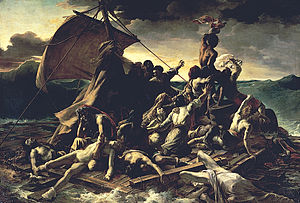
Théodore Géricault's Raft of the Medusa, circa 1820
Théodore Géricault's Raft of the Medusa (c. 1820), was a social commentary on a current event, unprecedented at the time. Édouard Manet's Le Déjeuner sur l'Herbe (1863), was considered scandalous not because of the nude woman, but because she is seated next to men fully dressed in the clothing of the time, rather than in robes of the antique world. John Singer Sargent's Madame Pierre Gautreau (Madam X) (1884), caused a huge uproar over the reddish pink used to color the woman's ear lobe, considered far too suggestive and supposedly ruining the high-society model's reputation.
In the twentieth century, Pablo Picasso's Guernica (1937) used arresting cubist techniques and stark monochromatic oils, to depict the harrowing consequences of a contemporary bombing of a small, ancient Basque town. Leon Golub's Interrogation III (1981), depicts a female nude, hooded detainee strapped to a chair, her legs open to reveal her sexual organs, surrounded by two tormentors dressed in everyday clothing. Andres Serrano's Piss Christ (1989) is a photograph of a crucifix, sacred to the Christian religion and representing Christ's sacrifice and final suffering, submerged in a glass of the artist's own urine. The resulting uproar led to comments in the United States Senate about public funding of the arts.

 From Wikipedia, the free encyclopedia

Conceptual Art and Artistic Skill

Adam. Detail from Michelangelo's fresco in the Cappella Sistin
Art can connote a sense of trained ability or mastery of a medium. Art can also simply refer to the developed and efficient use of a language to convey meaning with immediacy and or depth. Art is an act of expressing feelings, thoughts, and observations.[16] There is an understanding that is reached with the material as a result of handling it, which facilitates one's thought processes. A common view is that the epithet "art", particular in its elevated sense, requires a certain level of creative expertise by the artist, whether this be a demonstration of technical ability or an originality in stylistic approach such as in the plays of Shakespeare, or a combination of these two. Traditionally skill of execution was viewed as a quality inseparable from art and thus necessary for its success; for Leonardo da Vinci, art, neither more nor less than his other endeavors, was a manifestation of skill. Rembrandt's work, now praised for its ephemeral virtues, was most admired by his contemporaries for its virtuosity. At the turn of the 20th century, the adroit performances of John Singer Sargent were alternately admired and viewed with skepticism for their manual fluency, yet at nearly the same time the artist who would become the era's most recognized and peripatetic iconoclast, Pablo Picasso, was completing a traditional academic training at which he excelled.
A common contemporary criticism of some modern art occurs along the lines of objecting to the apparent lack of skill or ability required in the production of the artistic object. In conceptual art, Marcel Duchamp's "Fountain" is among the first examples of pieces wherein the artist used found objects ("ready-made") and exercised no traditionally recognised set of skills. Tracey Emin's My Bed, or Damien Hirst's The Physical Impossibility of Death in the Mind of Someone Living follow this example and also manipulate the mass media. Emin slept (and engaged in other activities) in her bed before placing the result in a gallery as work of art. Hirst came up with the conceptual design for the artwork but has left most of the eventual creation of many works to employed artisans. Hirst's celebrity is founded entirely on his ability to produce shocking concepts. The actual production in many conceptual and contemporary works of art is a matter of assembly of found objects. However there are many modernist and contemporary artists who continue to excel in the skills of drawing and painting and in creating hands-on works of art.

From Wikipedia, the free encyclopedia
Detail of Leonardo da Vinci's Mona Lisa
The creative arts are often divided into more specific categories, each related to its technique, or medium, such as decorative arts, plastic arts, performing arts, or literature. Unlike scientific fields, art is one of the few subjects that are academically organized according to technique [1]. An artistic medium is the substance or material the artistic work is made from, and may also refer to the technique used. For example, paint is a medium used in painting, and paper is a medium used in drawing.
An art form is the specific shape, or quality an artistic expression takes. The media used often influence the form. For example, the form of a sculpture must exist in space in three dimensions, and respond to gravity. The constraints and limitations of a particular medium are thus called its formal qualities. To give another example, the formal qualities of painting are the canvas texture, color, and brush texture. The formal qualities of video games are non-linearity, interactivity and virtual presence. The form of a particular work of art is determined by the formal qualities of the media, and is not related to the intentions of the artist or the reactions of the audience in any way what so ever.

A genre is a set of conventions and styles within a particular medium. For instance, well recognized genres in film are western, horror and romantic comedy. Genres in music include death metal and trip hop. Genres in painting include still life and pastoral landscape. A particular work of art may bend or combine genres but each genre has a recognizable group of conventions, clichés and tropes. (One note: the word genre has a second older meaning within painting; genre painting was a phrase used in the 17th to 19th centuries to refer specifically to paintings of scenes of everyday life and can still be used in this way.)
The style of an artwork, artist, or movement is the distinctive method and form followed by the respective art. Any loose brushy, dripped or poured abstract painting is called expressionistic. Often a style is linked with a particular historical period, set of ideas, and particular artistic movement. So Jackson Pollock is called an
From Wikipedia, the free encyclopedia
 
| Home | About Us | Sitemap | Privacy Policy |